Are you looking for a way to quickly and easily transform your balcony into a green oasis where you can enjoy plenty of privacy? Then ivy on your balcony is one of the wisest choices you can make. This incredibly strong climbing plant, officially known as Hedera, is popular for its deep green leaves that remain beautifully green even during the coldest winter days. This way, you’ll be wonderfully sheltered from the wind and prying eyes not only in summer, but all year round.
People living in apartments with railings often have an open view. This is great for the scenery and sunlight, but it sometimes offers little shelter. With ivy, you can naturally build a dense screen that immediately adds ambiance to your outdoor space. In this article, you'll discover all the benefits of ivy on the balustrade, how to give this climber the best care, and how to smartly arrange your space.
Why ivy on the balcony is the ultimate evergreen
There are many balcony plants available, but ivy has a few unique properties that make it an absolute favorite. It is one of the hardiest plants there is, making it extremely suitable for the sometimes unpredictable Dutch climate.

Here are the main advantages of ivy on the balcony:
- Year-round privacy: While many other climbing plants lose their leaves in autumn, ivy remains evergreen. Your balcony will always maintain its sheltered and cozy atmosphere.
- Rock-solid and incredibly strong: Ivy can withstand strong winds at height, bright sun, and even shady corners. It is a plant that rarely disappoints.
- Air purifying and noise reducing: The dense leaves of the plant filter out fine dust and dampen ambient noise from the street. This creates a peaceful atmosphere in your outdoor space.
- Easy to train: With its flexible tendrils, you can guide ivy exactly in the direction you want. This way, you can easily cover a bare fence or an unsightly wall.
Types of ivy for the balcony
If you choose ivy, it's good to know that there are different varieties available. The two most common types that do very well in planters are:
1. Common ivy (Hedera helix)
This is the most well-known variety. It has smaller, elegant leaves and grows nicely compactly. There are also very beautiful varieties with variegated leaves, such as green with yellow or silver-white. This immediately gives your balcony wall a playful and light effect.
2. Large-leaved ivy (Hedera hibernica)
This variety has larger, glossy leaves and grows faster than common ivy. If you want to create a dense privacy screen quickly, this type is a very smart choice. However, it does need more space for its roots, which requires a spacious pot on the ground.
Smartly furnishing your balcony with ivy
Furnishing a balcony with railings requires a clever approach. Of course, you don't want large pots to take up all your walking space or lightweight pots to blow over in the first storm. A climbing plant needs a solid base to support a large amount of leaves.
By cleverly utilizing the ground surface and the balustrade railings, you create a stable and space-saving setup.
A rock-solid base on the balcony floor
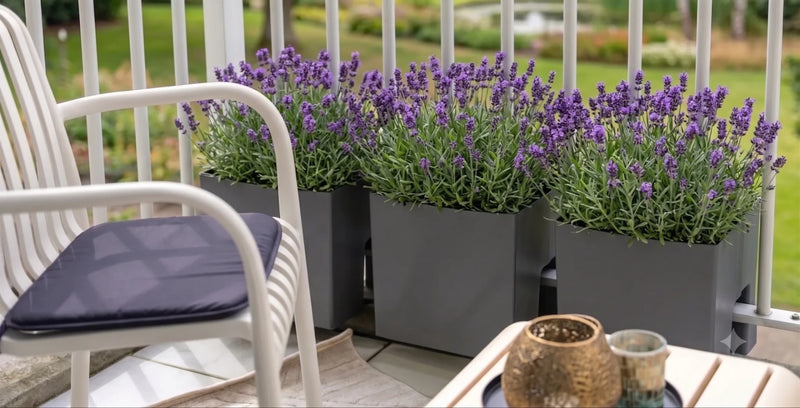
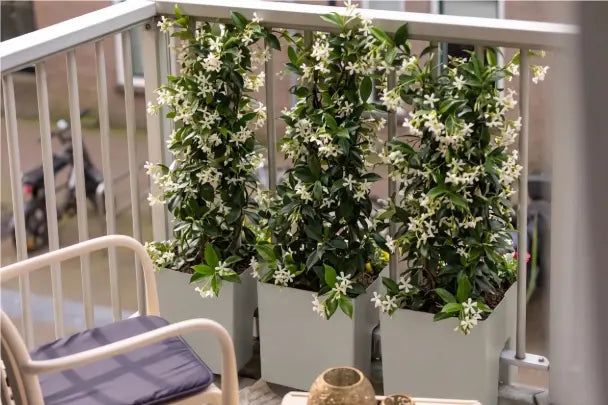
Our unique Vercony planter is specially designed for this living situation. You can easily place the planter through the railings on the balcony floor. Because a large part of the planter extends outside the balustrade, your balcony does not lose valuable floor space. The planter stands firmly on the floor, which is essential as the ivy grows higher and catches more wind.
Combine with trellises and other pots
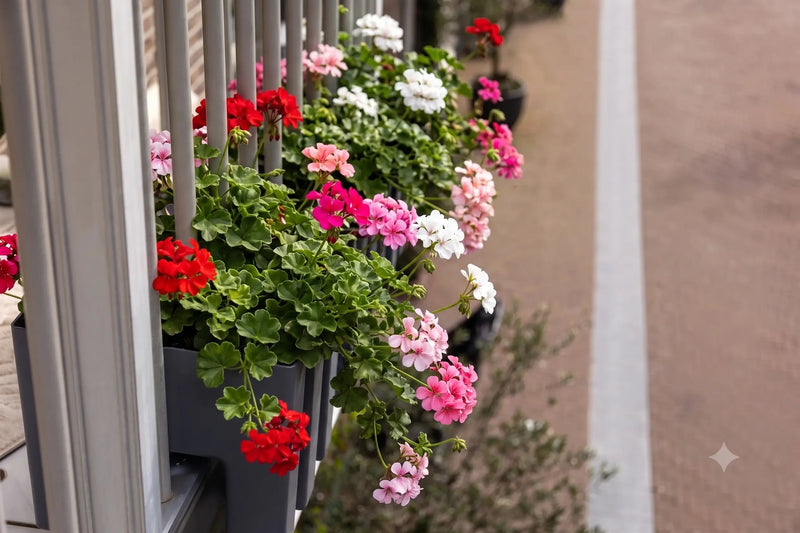
From the Vercony planter, you can easily weave the tendrils of the ivy through the railings of your fence, or let them grow up along a wooden trellis. Do you want a cheerful variation on your balcony? Feel free to combine the ivy on the ground with colorful hanging pots on the top rail, or place a few compact flower pots next to the main planter. Think, for example, of flowering summer bulbs that contrast beautifully with the dark green leaves of the ivy.
Maintenance and care of ivy on your balcony
Although ivy is one of the easiest plants to maintain, proper care helps keep the plant looking full and healthy. With these simple tips, your green wall will remain beautiful for years.
1. Location and light
Ivy is not at all picky. It grows well in full sun, but does just as well on a shady north-facing balcony. However, make sure young plants in full sun get enough water on very hot summer days.
2. Watering and proper drainage
Water ivy regularly, especially during dry and warm periods. The soil should remain slightly moist, but not soaking wet. Soggy roots can damage the plant. Our Vercony planter is designed so that excess watering and rainwater can easily drain away, keeping the soil healthy.
3. Pruning for a dense, full hedge
Pruning encourages growth, and that certainly applies to ivy! By trimming the shoots twice a year, for example in May and September, the plant will branch out faster. This will make your green wall even denser and keep it neatly within the desired boundaries.
Step-by-step plan: How to plant ivy on the balcony
Ready to transform your balcony into a green sanctuary? With this handy step-by-step guide, you can get started right away:
- Step 1: Place the planter. Slide the Vercony planter into the desired spot through the railings on the balcony floor.
- Step 2: Fill the planter with potting soil. Use nutrient-rich potting soil for outdoor plants to give the roots a strong start.
- Step 3: Plant the ivy. Remove the plants from their nursery pots and place them at equal distances from each other in the planter.
- Step 4: Guide the tendrils. Gently weave the longer branches through the fence railings or secure them to a trellis.
- Step 5: Give it a good drink of water. Make sure the soil is well moist so the roots can quickly establish themselves in their new environment.
Turn your balcony into a green haven with Vercony
Ivy on the balcony is the smartest way to enjoy an attractive, green, and secluded outdoor space all year round. With its incredibly strong character and beautiful leaves, you can quickly create a beautiful natural partition. With Vercony's innovative planter, you lay the most stable and space-saving foundation for your ivy on the balcony floor. Weave the branches upwards, possibly add some cheerful flower pots, and enjoy your own green paradise at height in peace and quiet!